8 Best PopSQL Alternatives in 2026
Eight PopSQL alternatives compared on scheduled reports, spreadsheet delivery and price, with a feature-by-feature parity check for teams migrating.
- Free for 14 days, no credit card
- Desktop app for Mac and Linux
- Rated 5.0 on G2 (2 reviews)
Updated 17 October 2026. Prices checked 17 October 2026 against each vendor’s own pricing page.
- Try SaturnSQL freeSaturnSQL€19/user/mo
Teams replacing PopSQL
- Hex$36 / $75 per editor/mo
SQL plus Python notebook work
- DBeaverFree / $113/yr
Free desktop use and broad engine support
- Beekeeper StudioFree / $9/mo
A clean local-first desktop client
- DataGripFree / €259/yr
JetBrains users, and free non-commercial use
- TablePlus$99 one-time
A one-time licence instead of a subscription
- Postico$99 one-time
macOS-native PostgreSQL work
- SQLPadFree, self-hosted
Self-hosting on your own infrastructure
Feature comparison
| SaturnSQL | Hex | UnifySQL | DBeaver | Beekeeper Studio | DataGrip | |
|---|---|---|---|---|---|---|
| Browser-based | ✓ | ✓ | ✓ | — | — | — |
| Shared query library | ✓ Paid | ✓ Paid | ✓ | — | ✓ Paid | — |
| Scheduled queries* | ✓ Paid | ✓ Paid | ? | — | — | — |
| Export to Google Sheets* | ✓ Paid | — | ? | — | — | — |
| Send to Slack* | ✓ Paid | ✓ Paid | ? | — | — | — |
| Dashboards & charts | ✓ Paid | ✓ | ✓ | — | — | — |
| AI SQL assistant* | Pro | ✓ | ✓ | ✓ | ✓ Paid | ✓ |
| Query version history* | Pro | ✓ Paid | ✓ | — | — | ✓ |
| Schema autocomplete | ✓ | ✓ | ✓ | ✓ | ✓ | ✓ |
| CSV & Excel export | ✓ | ✓ | ✓ | ✓ | ✓ | ✓ |
| Self-hosting | — | — | — | ✓ | ✓ | ✓ |
| PostgreSQL | ✓ | ✓ | ✓ | ✓ | ✓ | ✓ |
| MySQL / MariaDB | ✓ | ✓ | ✓ | ✓ | ✓ | ✓ |
| SQL Server | ✓ | ✓ | ✓ | ✓ | ✓ | ✓ |
| Redshift | ✓ | ✓ | ✓ | ✓ | ✓ | ✓ |
| ClickHouse | ✓ | ✓ | — | ✓ | ✓ Paid | ✓ |
| BigQuery | ✓ | ✓ | ✓ | ✓ | ✓ | ✓ |
| Snowflake* | Pro | ✓ | ✓ | ✓ | ✓ Paid | ✓ |
| Free tier* | 1 connection, 1 query, no sharing | Small compute, 5 apps | Free forever, core features | Community Edition, full | Community Edition, small orgs | Non-commercial only |
| Starting price | €19/user/mo | $36 (scheduling $75) | $12/editor/mo | Free / $113/yr | Free / $9/mo | Free / €259/yr |
✓ available · ✓ Paid = not on the free tier · Pro = Pro plan · ~ partial · ? not documented by the vendor · — not available
- Scheduled queries: Hex requires the $75 Team plan. UnifySQL: not documented on their pricing, features or integrations pages as of 3 August 2026.
- Export to Google Sheets: UnifySQL: not documented as of 3 August 2026.
- Send to Slack: UnifySQL: not documented as of 3 August 2026.
- AI SQL assistant: SaturnSQL: Pro plan.
- Query version history: SaturnSQL: Pro plan.
- Snowflake: SaturnSQL: Pro plan. UnifySQL lists Snowflake among its supported sources.
- Free tier: Beekeeper’s Community Edition is intended for organisations under 10 employees and/or under $1M revenue.
Prices checked 17 October 2026 against each vendor’s own pricing page: SaturnSQL · Hex · UnifySQL · DBeaver · Beekeeper Studio · DataGrip.
Where PopSQL stands now
Update · August 2026
The 1 September shutdown has been postponed
PopSQL is not shutting down on 1 September 2026 after all, and no data is being deleted. Tiger Data postponed the retirement with no new date, promising at least 90 days’ notice. It stays in limited support though: no new features, only critical security patches.
Worth remembering what was announced: until this reversal, PopSQL customers were told every saved query, connection and team setting would be permanently deleted and unrecoverable on 1 September 2026. That deadline was withdrawn about three weeks before it landed.
With the shutdown postponed there is no deadline to beat, but PopSQL is still a product being wound down, and the tool most teams used it for, SQL on a schedule delivered into a spreadsheet, is the hardest part to replace. Of the SQL editors here, only two do it self-serve: SaturnSQL at €19 per user per month and Hex at $75 per editor per month.
If it was the scheduled reports you used PopSQL for
Most of the editors below will run your queries. Only two will run them for you every morning and put the rows in a spreadsheet, and SaturnSQL is the cheaper of the two. It has a free plan, so you can test the fit before any deadline reappears, and the migration guide linked below walks through moving your queries.
New to the news? Read the PopSQL shutdown overview. Already decided? Jump to the step-by-step migration guide. Losing SeekWell too? See our SeekWell alternatives comparison.
What PopSQL did, and where it lands
| What PopSQL did | Where it lands in SaturnSQL | Verdict |
|---|---|---|
| Shared query library | Shared SQL library on Starter | Same |
| Scheduled queries | Scheduling on Starter, minute-level precisionPopSQL Premium was daily, Business was hourly. | Better |
| Dashboards | Dashboards with a shared filter bar and folders | Same |
| Charts | Report charts, drawn automatically with overrides | Same |
| Google Sheets export | Scheduled export to Google Sheets | Same |
| Version history | Query version history, Pro plan | Worse |
| dbt integration | Nothing equivalentIf dbt actions were core to your workflow, Hex is the closer fit. | Missing |
| Git integration | Nothing equivalent | Missing |
| Snowflake connections | Pro planDBeaver and Hex support Snowflake today. | Worse |
| Free tier | 1 connection, 1 saved query, no sharingPopSQL’s free tier allowed 2 connections, 2 dashboards and 2 schedules. If you need a free tool, use DBeaver Community Edition or DataGrip non-commercial. | Worse |
What you were paying, and what this costs
PopSQL Premium was $19 per editor per month and Business was $36. SaturnSQL Starter is €19 per user per month, and it includes scheduling at minute-level precision, which PopSQL only offered hourly on the $36 Business plan.
If you were on PopSQL’s free tier, be warned: ours is thinner. PopSQL gave you two connections, two dashboards and two weekly schedules for nothing. SaturnSQL’s free tier is one connection and one saved query with no sharing. For genuinely free, use DBeaver Community Edition or DataGrip’s non-commercial licence.
Desktop tools are cheaper than all of this. TablePlus is $99 once and Postico is $99 per device, both perpetual. Neither can run a query on a schedule and put the results in a spreadsheet, which is the whole reason most PopSQL teams are here.
Why teams switch
Three things that quietly eat a data team's week, and what changes with SaturnSQL.
Queries nobody can find
Queries live in Slack threads, Google Docs, and random .sql files nobody can find when they need them.
One shared query library.Save a query once and anyone on the team can find it, run it, and build on it.
No shared database access
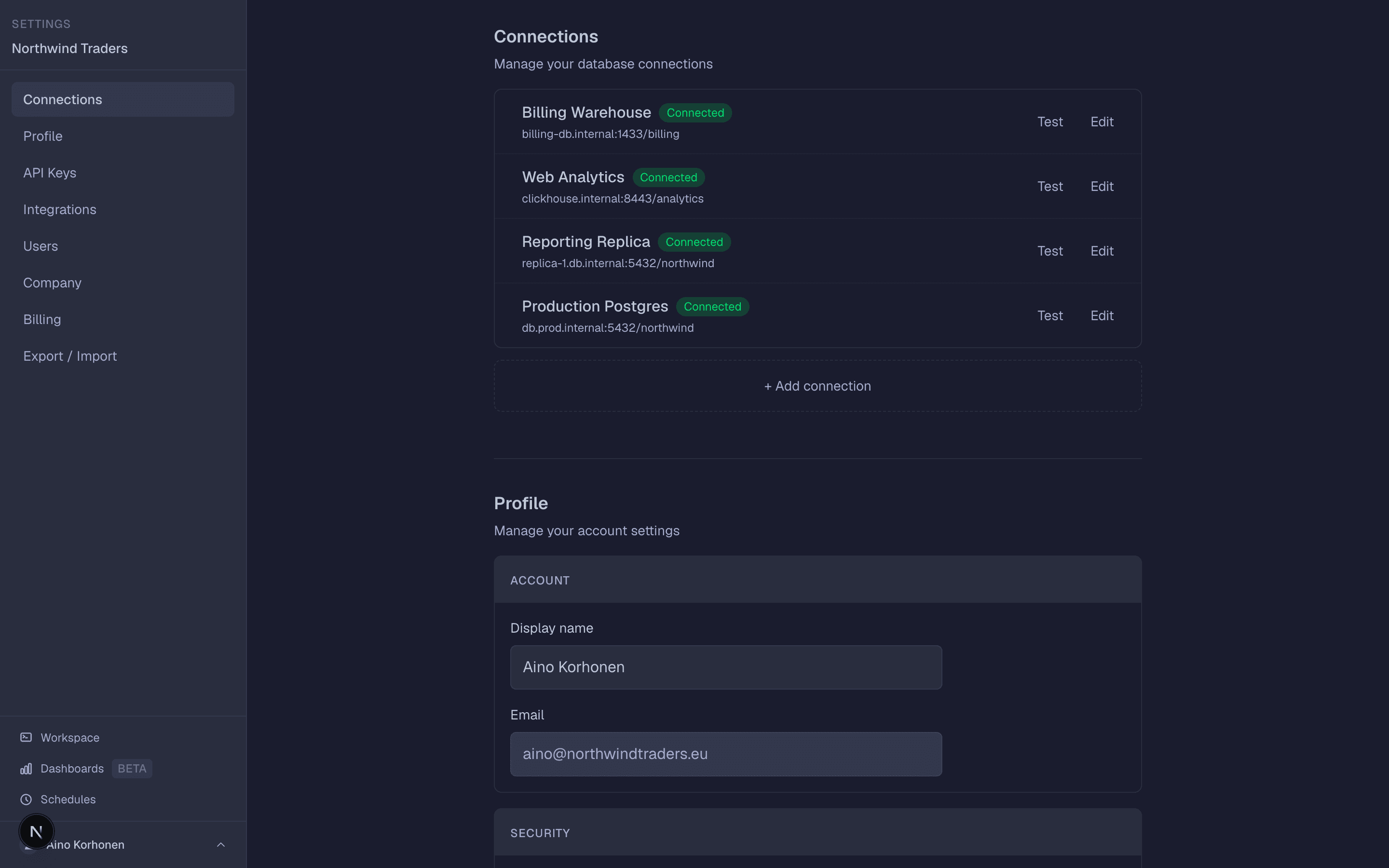
Credentials are shared over DMs. New team members wait days before they can even run a query.
Connect the database once.Teammates sign in and query it from day one, and nobody ever sees the password.
Reports refreshed by hand
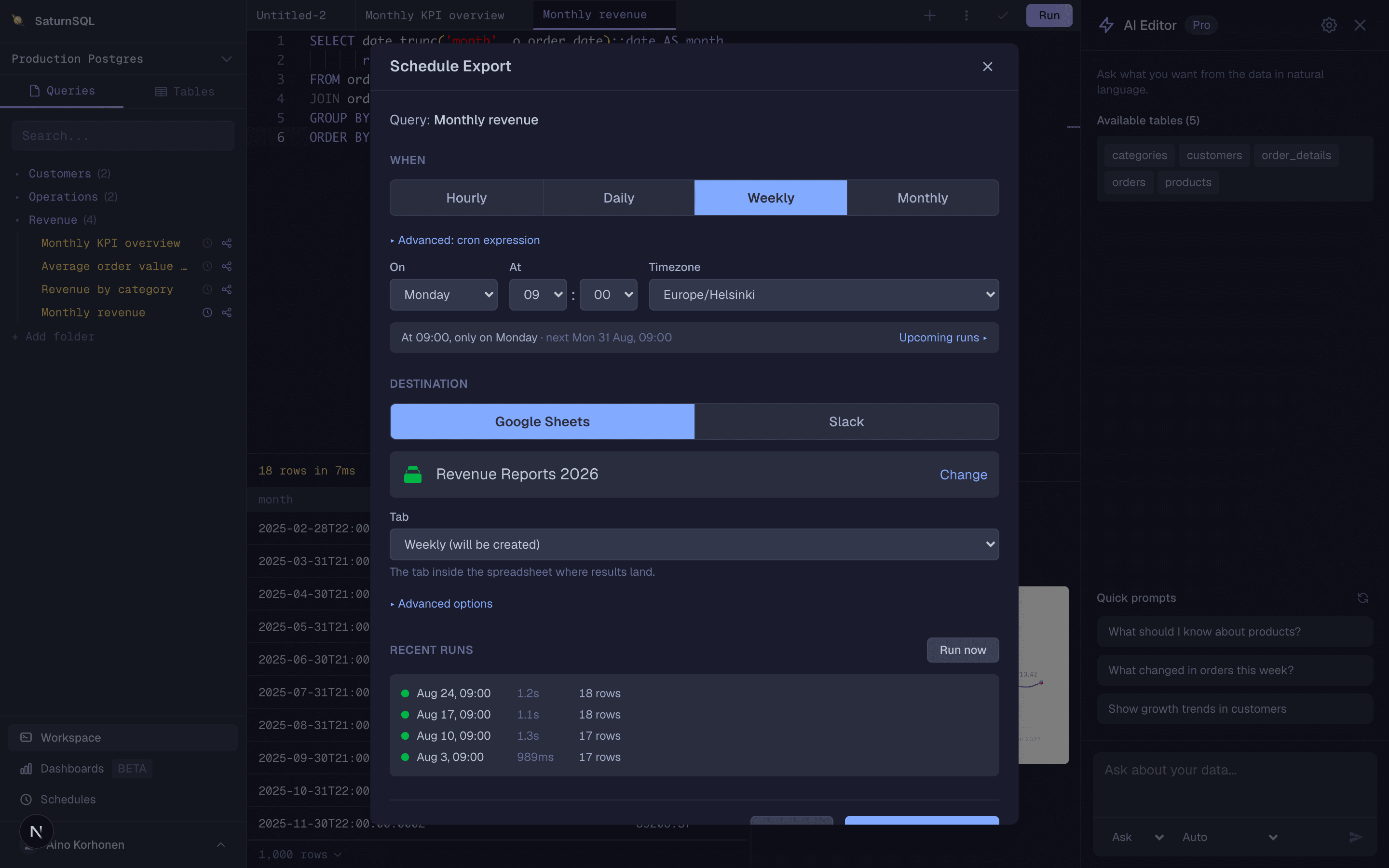
Someone re-runs the same query every Monday and pastes the results into Google Sheets. It’s stale by Tuesday.
Schedule it once.It refills the Google Sheet or posts to Slack on its own, every hour or every Monday at 07:00.
The 8 best PopSQL alternatives
SaturnSQL
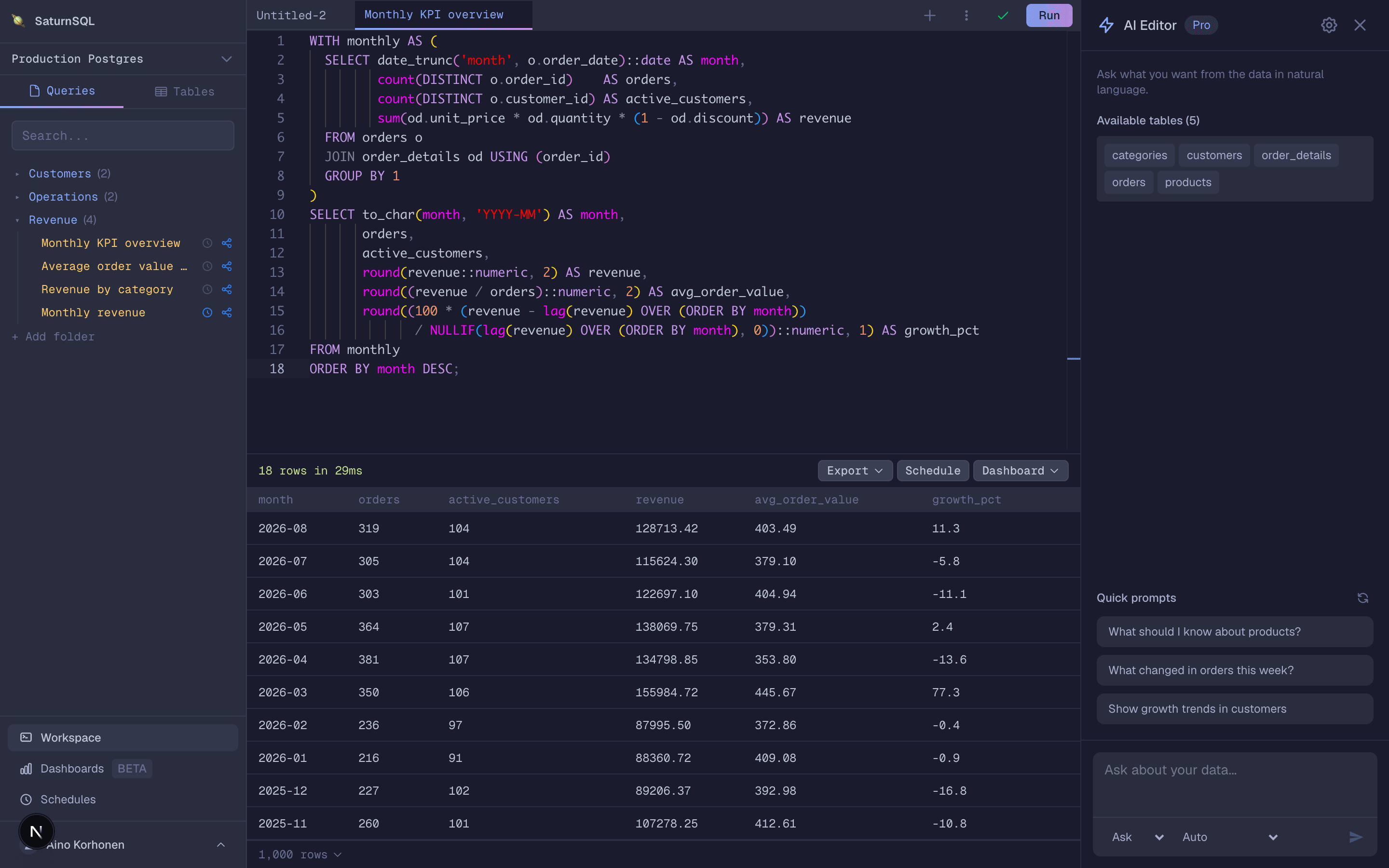
Best for: Teams replacing PopSQLSaturnSQL is a browser-based collaborative SQL editor with a shared query library, dashboards and minute-level scheduled delivery to Google Sheets and Slack, from €19 per user per month.
Strong
- + Scheduled delivery to Google Sheets and Slack, minute-level
- + Shared query library and dashboards
- + Eight engines including Redshift, ClickHouse and BigQuery
- + Cheapest self-serve tool with scheduled delivery
- + Hosted MCP server, so Claude, ChatGPT or Cursor can query your databases
Limits
- − Snowflake only on Pro
- − No self-hosting
- − No Python or notebooks
- − Free tier is a demo: 1 connection, 1 saved query, no sharing
Pricing: Starter €19 per user per month, including scheduling. Pro is €79 per seat per month, through sales. Free tier is 1 connection and 1 saved query with no sharing. pricing page, checked 17 October 2026.
Hex
Best for: SQL plus Python notebook workHex is a collaborative notebook workspace combining SQL, Python and no-code cells, but its scheduled runs and alerts are gated to the Team plan at $75 per editor per month.
Strong
- + SQL and Python in one notebook
- + Interactive data apps for stakeholders
- + Connects to most warehouses including Snowflake
Limits
- − Full scheduling, Slack notifications and cron need the $75 Team plan; Professional gets one scheduled run per project
- − Notebook model is a steeper learning curve than a SQL workspace
Pricing: Community free (small compute, up to 5 published apps). Professional $36 per editor per month, limited to one scheduled run per project with no Slack notifications or cron. Team $75 per editor per month for full scheduling and alerts. Enterprise custom. pricing page, checked 17 October 2026.
DBeaver
Best for: Free desktop use and broad engine supportDBeaver is a universal desktop database tool with a genuinely free Community Edition, supporting nearly every engine, but no team collaboration or scheduled delivery.
Strong
- + Community Edition is free and open source
- + Supports almost every database including Snowflake and Oracle
- + ER diagrams, import and export, SQL formatting
Limits
- − Desktop only, no shared query library
- − No scheduled delivery to Sheets or Slack
- − CloudBeaver Enterprise, the browser version, is $1,025 per year (Community is free)
Pricing: Community Edition free. Lite $113 per year ($12 per month). Enterprise $255 per year. Ultimate $510 per year. CloudBeaver Enterprise, the browser product, $1,025 per year. pricing page, checked 17 October 2026.
Beekeeper Studio
Best for: A clean local-first desktop clientBeekeeper Studio is a polished cross-platform desktop SQL client whose free Community Edition is intended only for organisations under 10 employees and/or under $1M revenue.
Strong
- + Clean modern interface, local-first
- + Paid tiers include a lifetime access licence
- + Cheapest paid desktop option at $9 per month billed annually
Limits
- − Community Edition is not intended for most real companies
- − No scheduled delivery, shared queries only on Professional and up
Pricing: Community Edition free, intended for organisations under 10 employees and/or under $1M revenue. Indie $18 per month, or $9 billed annually. Professional $28, or $14 annually. Business $35, or $18 annually. pricing page, checked 17 October 2026.
DataGrip
Best for: JetBrains users, and free non-commercial useDataGrip is JetBrains’ database IDE with deep code intelligence, free for non-commercial use since October 2025 and €259 per user per year for organisations.
Strong
- + Free for non-commercial use
- + IntelliJ-grade code intelligence and refactoring
- + Yearly subscriptions include a perpetual fallback licence
Limits
- − Desktop IDE, no team query library or scheduling
- − Commercial use is €259 per user per year
Pricing: Free for individual non-commercial use. Organisations €259 per user per year, flat, with a perpetual fallback licence. 30-day trial. pricing page, checked 17 October 2026.
TablePlus
Best for: A one-time licence instead of a subscriptionTablePlus is a fast native database GUI sold as a perpetual licence from $99, which works out cheaper than any subscription tool after the first few months.
Strong
- + Buy once, use forever, from $99
- + Fast native app on macOS, Windows and Linux
Limits
- − Only one year of updates included
- − No collaboration or scheduled delivery
- − Free trial is capped at 2 tabs and 2 windows
Pricing: Basic $99 per licence (1 device). Standard $129 (2 devices). Team $79 per seat, minimum 3 seats. Perpetual, with one year of updates included. pricing page, checked 17 October 2026.
Postico
Best for: macOS-native PostgreSQL workPostico is a native macOS client for PostgreSQL and Redshift sold as a perpetual licence, $99 per device commercially or $69 for personal use.
Strong
- + Clean native Mac app
- + Perpetual licence, transferable within your organisation
- + Evaluation licence has no time limit
Limits
- − macOS 14 or later only
- − PostgreSQL family only, no MySQL or SQL Server
- − No collaboration or scheduling
Pricing: Commercial $99 / €90 per device. Team $799 / €730 for up to 10 devices. Personal $69 / €62 for up to 3 devices. Student $29. All perpetual. pricing page, checked 17 October 2026.
SQLPad
Best for: Self-hosting on your own infrastructureSQLPad is a free open-source browser-based SQL editor you host yourself, which trades zero licence cost against setup and maintenance effort.
Strong
- + Free and open source
- + Browser-based without a third-party service
- + Full control over where data lives
Limits
- − You run and maintain the server
- − No scheduled delivery to Sheets or Slack
- − The project was archived in August 2025 and is no longer developed
Pricing: Free and open source. You provide the hosting. pricing page, checked 17 October 2026.
Also in the market
Two more browser-based options that did not make the ranked list, one because we could not verify its core workflow and one because of its price.
UnifySQL
Best for: Cheapest entry price with AI includedUnifySQL is a browser-based SQL editor starting at $12 per editor per month with AI and real-time collaboration included, but no scheduled delivery is documented on its pricing, features or integrations pages as of 3 August 2026.
Strong
- + Cheapest entry price at $12 per editor per month
- + AI assistant and version history included at the entry tier
- + Real-time collaboration with live cursors and comment threads
- + A genuine free-forever tier
Limits
- − No scheduled queries or Sheets/Slack delivery documented
- − Their own pages give varying database counts (5+, 17 logos, 20+)
Pricing: Free-forever tier. Starter $12 per editor per month (10 connections). Professional $22. Enterprise $39. 20% discount billed annually. pricing page, checked 17 October 2026.
CloudBeaver
Best for: DBeaver in the browserCloudBeaver is DBeaver’s browser-based product, which brings the same broad engine support to a web UI at $1,025 per year for the Enterprise licence.
Strong
- + Browser-based with DBeaver’s engine coverage
- + Can be self-hosted
Limits
- − Enterprise at $1,025 per year is far above self-serve SQL editor pricing
Pricing: CloudBeaver Enterprise $1,025 per year, with volume options. CloudBeaver Community Edition is free and open source. pricing page, checked 17 October 2026.
Adjacent: BI and notebooks
Different category. Reach for these if the real goal is dashboards for stakeholders rather than a SQL workspace for analysts. See also our SQL dashboards page, and the deeper SaturnSQL vs Hex and SaturnSQL vs DBeaver comparisons.
Metabase
Best for: Dashboards for non-SQL stakeholdersMetabase is a BI tool with a SQL editor attached, best when the goal is self-serve dashboards for people who do not write SQL rather than a SQL workspace for people who do.
Strong
- + Strong dashboards
- + Open-source edition available
- + Non-technical question builder
Limits
- − BI first, SQL editor second
- − Not a shared query library for analysts
Pricing: Open-source edition free and self-hosted. Paid cloud plans available. pricing page, checked 17 October 2026.
Mode
Best for: Analyst reporting on top of SQLMode is a BI platform with a strong SQL editor and scheduled report delivery, acquired by ThoughtSpot in 2023, the same company that acquired SeekWell in 2021 and is shutting it down in 2026.
Strong
- + Capable SQL editor
- + Scheduled delivery by email, Slack and webhook
- + Rich charts and reports
Limits
- − Pro and Enterprise plans go through sales, not self-serve
- − Owned by ThoughtSpot, which is shutting SeekWell down. Worth checking the roadmap before standardising on it.
Pricing: Free Studio plan. Pro and Enterprise plans via sales. pricing page, checked 17 October 2026.
Redash
Best for: Self-hosted query sharing and dashboardsRedash is an open-source query and dashboard tool you self-host, acquired by Databricks in 2020, with releases stalling until they resumed in 2025.
Strong
- + Open source and self-hosted
- + Query sharing and dashboards in one place
Limits
- − Releases stalled for years after the Databricks acquisition
- − You run the infrastructure
Pricing: Open source, self-hosted. The managed service was retired after the Databricks acquisition. pricing page, checked 17 October 2026.
Dead ends: do not migrate to these
This category has a habit of consolidating. Tools here die, get absorbed, or pivot upmarket, and every one of those paths leads away from a small team that just wants SQL on a schedule. Worth knowing before you migrate onto something that is already on its way out.
| Tool | What happened | Status |
|---|---|---|
| PopSQL | Acquired by Timescale (Tiger Data), moved to limited support in 2025 source | Shutdown postponed, 90 days’ notice promised |
| SeekWell | Acquired by ThoughtSpot in 2021 source | End of life 31 July 2026, data deleted within 30 days |
| Arctype | Acquired by ClickHouse in October 2022, folded into ClickHouse Cloud | Discontinued 6 December 2022 |
| Chartio | Acquired by Atlassian | Shut down March 2022 |
| Periscope Data | Folded into Sisense, brand retired | Gone |
| Galaxy | Pivoted to enterprise context management, pricing page now returns 404 | No self-serve SQL product as of August 2026 |
How we judged
We ranked on how completely each tool replaces what PopSQL actually did: a shared query library, scheduled queries, delivery into Google Sheets or Slack, dashboards, and a browser-based editor a whole team can use. Every price was re-checked against each vendor’s own pricing page on 17 October 2026 and is linked from its entry above. Where a competitor beats SaturnSQL we have said so in its Limits list.
Frequently asked questions
When is PopSQL shutting down?
There is no shutdown date any more. PopSQL was due to shut down on 1 September 2026, and customers had been told every saved query, connection and team setting would be permanently deleted and unrecoverable on that date. In August 2026, about three weeks before the deadline, Tiger Data postponed the retirement with no new date set and committed to at least 90 days’ notice beforehand. Nothing is being deleted now, but PopSQL stays in limited support mode, receiving only critical security fixes.
What is the best PopSQL alternative for teams?
For teams that relied on PopSQL’s scheduled queries and shared library, SaturnSQL is the closest self-serve replacement at €19 per user per month. Hex also does scheduled runs, but only on its Team plan at $75 per editor per month. If you do not need collaboration or scheduling, DBeaver and DataGrip are cheaper.
Is there a free PopSQL alternative?
Yes, but not from us. DBeaver Community Edition is free and open source, DataGrip is free for non-commercial use, and SQLPad is free if you self-host it. Beekeeper Studio’s Community Edition is free only for organisations under 10 employees and under $1M revenue. SaturnSQL has a free tier but it is a demo: one connection, one saved query, no sharing.
How do I migrate my queries from PopSQL?
In bulk, if your team used PopSQL’s GitHub Sync: it pushes every shared query and folder to a repository as .sql files, and SaturnSQL’s Saved Queries panel has an Import queries button that takes that folder or .zip, recreates the folder structure and skips duplicates. For personal queries that were never shared, use the query’s three-dot menu in PopSQL and choose Download as .sql. Our step-by-step guide is at saturnsql.com/help/migrate-from-popsql.
Is PopSQL still being wound down?
Yes, just without a deadline. PopSQL was acquired by Timescale (Tiger Data), moved to limited support in 2025, and had a shutdown announced for 1 September 2026 that was then postponed in August 2026. It remains in limited support with no new features planned. Standalone SQL editors are a hard business: too niche for enterprise sales, too costly to maintain as an indie tool.
How do I know SaturnSQL will not shut down too?
You do not, and we will not pretend otherwise. What we can tell you is structural: SaturnSQL is independently owned, so there is no acquirer or investor exit clock driving a shutdown, and your work is portable by design. Queries are plain SQL you can export at any time, and results export to CSV, Excel, Google Sheets and Slack. If we ever did disappear, you would leave with everything you put in. That is the only promise anyone in this category can honestly make.
Is there a PopSQL alternative that works with Claude or ChatGPT?
Yes. SaturnSQL includes a hosted MCP server on the Starter plan. Add https://mcp.saturnsql.com/mcp to Claude, ChatGPT, Cursor or Claude Code, sign in with your SaturnSQL account, and the assistant can list your connections, read schemas and run queries with the same row limits as the editor. It never sees your database passwords, and no API key is needed.
SaturnSQL is a browser-based collaborative SQL editor with a shared query library, dashboards and minute-level scheduled delivery to Google Sheets and Slack, from €19 per user per month.
This comparison is also maintained as an open list on GitHub. Spotted a price that has changed? Open an issue.
